

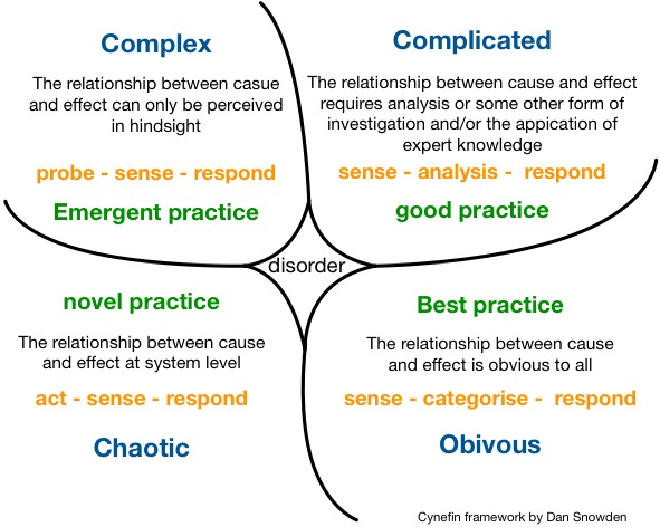
Management is about decision-making; but not all situations are created equal. A budgeting error is simple (cause-and-effect is obvious), an ERP integration is complicated (knowable with expert analysis), digital-platform disruption is complex (patterns emerge only in retrospect), and a ransomware outbreak is chaotic (no clear relationships exist)1. Applying a “one-size-fits-all” toolset ignores these distinctions and tempts managers to force certainty onto what is fundamentally uncertain.
The result is brittle plans, illusionary KPIs, and a nasty surprise when reality diverges.
Framing situationally does three big things:
- Selects the right playbook. Matching context to method stops managers from using simple sequential logic in a volatile situation, or from brainstorming during chaos.
- Surfaces hidden bias. Explicitly naming volatility, uncertainty, complexity and ambiguity makes cognitive shortcuts—anchoring, availability, overconfidence—visible and therefore challengeable2.
- Protects agility. When a decision is treated as an experiment in a complex space, manager are more willing to probe–sense–respond, iterate fast, and abandon sunk costs.
A growing toolkit helps managers label the terrain:
- Cynefin Framework – classifies contexts into simple, complicated, complex, chaotic, and confused1.
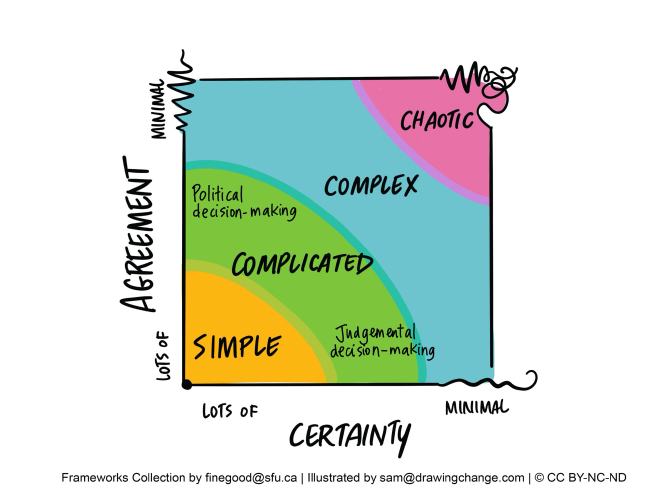
- Stacey Matrix – maps the degree of certainty and stakeholder agreement to suggest command, consult, collaborate or experiment3.
- VUCA lens – scans Volatility, Uncertainty, Complexity, Ambiguity to shape leadership stance4.
- Robust Decision-Making (RDM) – stress-tests options against thousands of plausible futures when deep uncertainty reigns5.
Managers should look to implement these models into governance: initial project charters could include a “situation quadrant”, executive dashboards flag when conditions migrate, and retrospective reports capture how framing influenced outcomes.
In hope, over time the organisation stops asking, “What’s the best practice?” and starts asking, “What’s the nature of our reality—and therefore the next wise move?” This understanding is a key indicator of good, modern management.
-
Snowden, D. J. & Boone, M. E. (2007). A Leader’s Framework for Decision Making. Harvard Business Review. ↩︎ ↩︎
-
Tversky, A. & Kahneman, D. (1974). Judgment under Uncertainty: Heuristics and Biases. In: The Use of Heuristics in Decision Making under Risk and Uncertainty. Springer. ↩︎
-
Praxis Framework. The Stacey Matrix (accessed 2025). ↩︎
-
Bennis, W. & Nanus, B. (1987). VUCA concept; U.S. Army War College usage. ↩︎
-
RAND Corporation. Robust Decision Making (RDM) overview (accessed 2025). ↩︎